


Among the Sicilian excellences we are covering in our column, today we turn to the world of coffee. The company we visited, known in Italy and abroad, is called Morettino. It’s based in Palermo and boasts more than a century of history carried on by a long family tradition, which is now more alive than ever. It’s a Sicilian attempt, so to speak, to challenge the primacy of coffee, which is generally attributed to Naples. Arturo Morettino’s project is now being carried on with joy and dedication by his grandchildren: Alberto, Alessandro, and Arturo, the latter being the father of Andrea, representative of the fourth generation to take care of the family brand. Morettino was founded in 1920 as a spice and colonial goods shop, then, at the behest of the founder’s son Angelo, it became a coffee roaster in the 1950s. Today, the company has about forty employees and its product represents regional excellence.

We’re welcomed at the headquarters by Arturo, who immediately shows the contagious enthusiasm of entrepreneurs who love their work and their creations. And he is certainly not wrong: the espresso we taste—shortly after nearly breaking a cup that fortunately, turned out to be indestructible—is exceptional. To describe the detailed process from grinding the beans to using the coffee machine, Arturo tells us that he is “tuning his instruments like a musician.” The taste proves him right, to say the least; the flavor is a symphony.
But Arturo is not satisfied with the quality of his product. He has a deep love for coffee and the culture it embodies, and he is keen to point out that every part of the company has tools—both ancient and modern—related to the preparation of this beverage. He explains and recounts this and more in a small classroom dedicated to coffee – the “Morettino Coffee School” – where you can find the varieties produced, two espresso machines, and an illustration of the production process that takes coffee from the plant to the cup. The school offers courses for professional and amateur baristas: “there is no flavor without knowledge” is one of Arturo’s mantras.
The reflection that arises from conversation concerns the lack of knowledge about coffee, despite the fact that, in terms of variety of aromas and complexity, it is not too dissimilar from wine, about which we often know much more. On the other hand, the plant from which coffee derives grows in distant, tropical countries, except, as we shall see, for a few exceptions made possible by climate change. Another reason could be linked to its use for less pleasant purposes than those associated with wine, which is usually consumed in more recreational circumstances, as it were, than those associated with coffee. But these are details.
Returning briefly to the plant, we come to the company’s most significant surprise, namely the cultivation of coffee near the city of Palermo, a novelty now sadly made possible by climate change. It is no coincidence that in Sicily it is common to find crops of tropical fruits such as mangoes, papayas, avocados, and kiwis. Morettino’s project began about thirty years ago in the village of San Lorenzo ai Colli and is supported by the University of Palermo and the Botanical Garden, which collaborate on research into what is one of the northernmost coffee plantations in the world. The ‘fruits’ of the project are growing year by year: in 2021, the harvest reached around 20 pounds and in 2024, 60 pounds. Although for now this project is not yet commercialized, it’s not impossible that this may happen in the future.

We continue our tour by visiting the production area, where the process goes from roasting to packaging—here photography is not allowed. In a long room filled with objects is the museum, or “Fabbrica Museale Morettino” as it’s called by the company. This is a place where around a thousand historical objects related to the processing and preparation of coffee from 1600 to the present day are kept, all meticulously collected by Arturo Morettino. The detail of his explanations and the passion he nurtures are the extra element, and it is no coincidence that he is present at all the tours that take place in the company and its museum. The range of objects on display tells the story of this beverage, for which a comparison with bread is not too far-fetched, considering its importance to humanity. Upon entering this place, we realize that coffee has managed to combine history, anthropology, engineering, hydraulics, and design. The whole world is involved, from Brazil to Ethiopia, from the Middle East to Italy, and you can get a fascinating taste of all this in this museum.
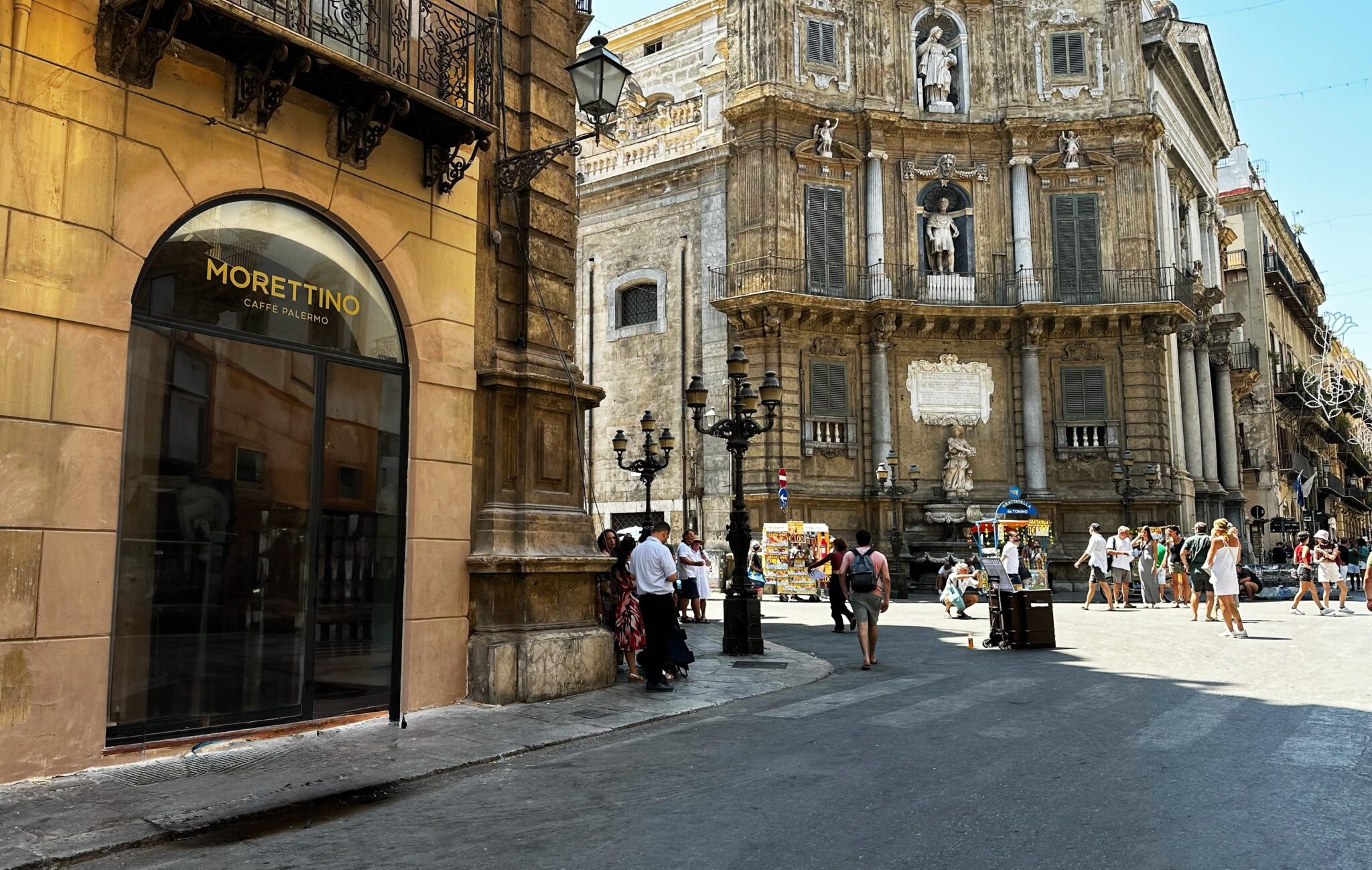
Today, Morettino is not only an exceptional Sicilian company that produces an excellent product, but in recent years it has also opened two bars, both in some of the most beautiful areas of the city. One is located at Quattro Canti, an emblematic place in the city of Palermo, and the other at Molo Trapezoidale, a brand new building near the port of Cala, another place to visit if you are in the city. In short, two chic places where a wide variety of coffee drinks are served to accompany sweet or savory foods.

Morettino fully qualifies as a great example of Sicilian entrepreneurship. It therefore deserves a mention and a visit to appreciate it, not only for the taste of its coffee, but also for its history and culture—it’s a drink that’s an integral part of our everyday experience.