

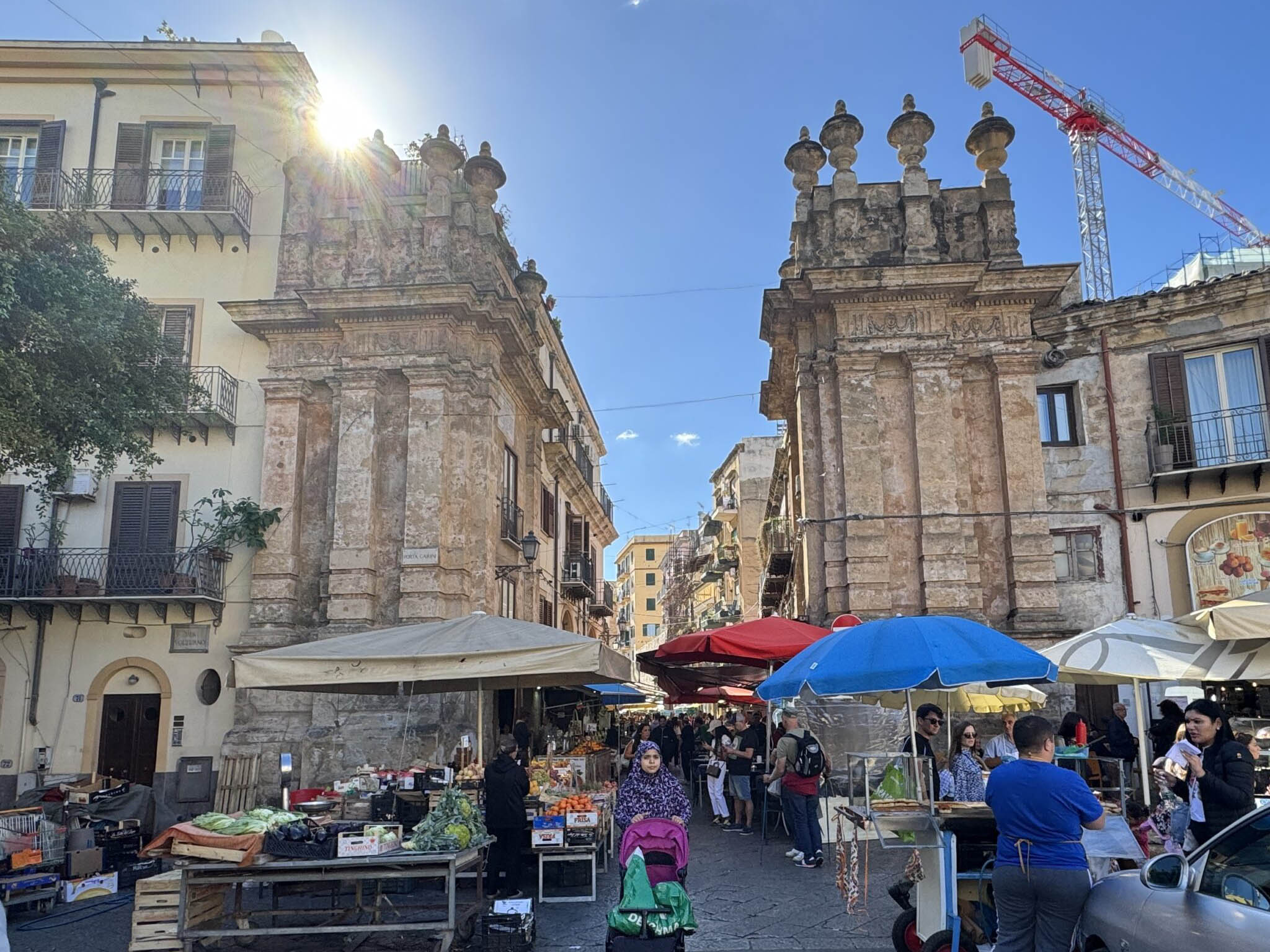

Visiting the city of Palermo means encountering its many facets; rich in monuments, churches, and squares, all in one of the most complex and largest historic centers in Europe. The narrow streets that animate it are a maze that leads to the discovery of unique places, sometimes decadent and sometimes majestic. Decadence is one of the recurring features of the city of Palermo, another is its cultural mix, what in London and the United States is called a “melting pot.” Here, the people of Palermo—with an attitude that is sometimes “racist,” of course, but also with the friendliness and typical hospitality that characterizes them—simply refer to foreigners with dark skin as Turkish, regardless of their actual origin. The cultural diversity of Palermo is vividly evident both in the faces of its people and in its architecture, the result of the mingling of the populations who have lived here over the centuries. Another sign of this is the markets, picturesque places that make Palermo look more like an Arab city than an Italian one.
Palermo’s markets, one of the city’s must-see attractions, are mainly three in number and take their names from the neighborhoods that host them: Vucciria, Capo, and Ballarò. All three offer all kinds of food, from fruit and vegetables to meat and fish. A special feature of all three, especially Vucciria, is their on-site gastronomic offerings, where you can sample much of the city’s culinary tradition, in which street food plays a central role. There is no shortage of typical offal dishes – stigghiole and bread with spleen, panelle (made from chickpea flour) and potato croquettes, as well as fish. The food is displayed raw, chosen and cooked on request on the grills and fryers that fill the central square, Piazza Caracciolo. The flavors are inevitably strong and often surprise those who try them, but the appreciation rate of those who encounter them is high.

The Ballarò market is another story altogether, much larger and richer in its offerings, but here too there is plenty of street food. As always, everything is shaded by large colorful awnings, and once again there is a vast array of food on offer, in addition to household items, clothing, electronics, and various types of upholstery. This is perhaps the liveliest of the three markets, with music and shouting accompanying you on this long walk, where it will be almost impossible not to buy or try something. All three markets are clearly popular, but this is perhaps the one where this dimension is most evident. Ballarò, Vucciria, and Capo have all been subject to the well-known process of gentrification, which is also evident in the city of Palermo, where renovated building entrances stand side by side with others in visibly worse condition. Palermo is undoubtedly a city of stark contrasts.

Finally, there is Capo, perhaps the most aesthetically beautiful of the three, thanks in part to the presence of the wonderful Church of the Immaculate Conception, which peeks out from among the merchants’ awnings. Smaller than Ballarò and larger than Vucciria, Capo is accessed through one of the oldest gates in the city, Porta Carini. Once through the entrance gate, Via Sant’Agostino begins, along which the market extends. Here begins the classic whirlwind of these places, with shouting, clamoring, and all kinds of local products displayed on the stalls. The confusion slows down the pace and, despite the modernity that has pervaded even these places, there remains a good dose of tradition, with young and old people who live in the city haggling over the price of fish or asking questions about the quality of the fruit. “Are these peaches tastier than those?” asks a customer. “No, they’re all very tasty,” replies the greengrocer, typically, as it would be sacrilegious to discredit one’s own product in favor of another. “2.50 euros, you want it?” asks a woman, probably from Sri Lanka or Bangladesh, who owns a fruit and vegetable shop in Ballarò. “No, too expensive,” replies a man in his eighties from Palermo. The markets are alive and well, especially in Ballarò, which seems endless in length.

Once we have finished our tour, we find ourselves in Via Maqueda, the very long street that runs through the historic center, dividing it in two. After the noise and odors of the market, we thought we were in a free zone, but we are immediately assailed by the strong smell of spicy Indian food. We continue walking until we lose ourselves in the narrow streets of Palermo. Getting lost in this huge historic center and its markets is another must-do.