

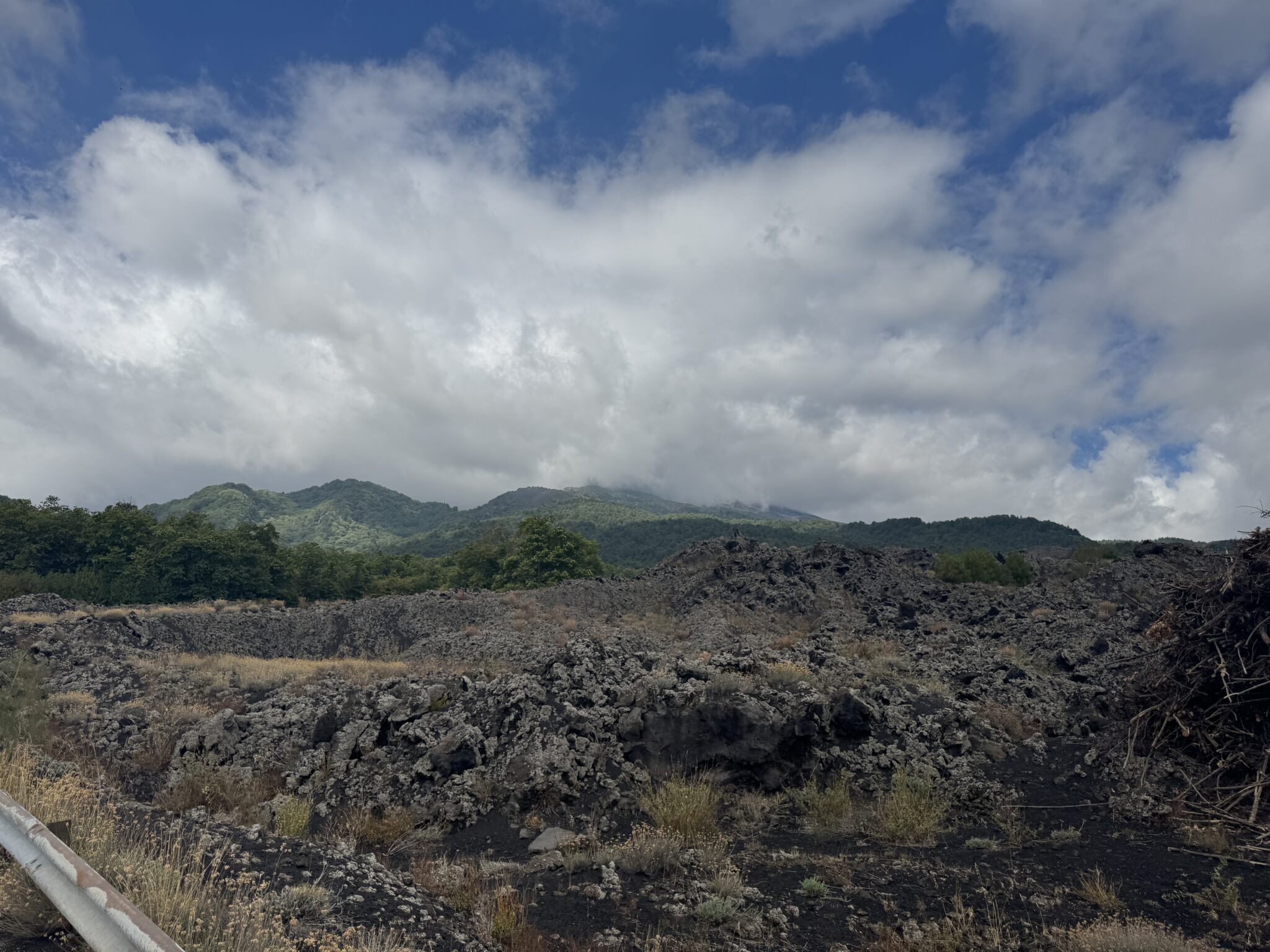

In this episode, we visit Mount Etna, one of the most sought-after tourist destinations in Sicily, as well as one of the most beautiful and appreciated on the island. On Mount Etna, Sicily is transformed once again. Here, we are no longer simply far from the beaches and the sea or the inland areas of the Madonie or Nebrodi mountains. We find ourselves on one of the most active volcanoes in the world, in a completely different and unique landscape, created and nourished by periodic and frequent eruptions. The volcano is alive and its eruptions constantly change its height – according to the latest survey, reaches 11,155 feet above sea level. The place where the peak is reached also changes, as does the surrounding landscape: Etna is alive and well, and it shows.
Apart from the small, beautiful villages that populate the slopes of the great volcano, one example of which is Castiglione di Sicilia, Etna can be visited and on foot. One way to enjoy this unique experience is to rely on the Etna Discovery travel agency, which organizes all kinds of tours. Depending on your level of experience and physical fitness, you can go on more or less intense treks or excursions mainly by car. We opted for the latter, which also includes pick-up from the hotel. The agency has seven Range Rover 4×4 off-road vehicles and a minibus, also a 4×4, so there are no limits to the events or team building activities that can be organized.
Lucia, a certified volcanological guide—a highly prestigious qualification on a par with that of mountain guides—and a consummate professional, led us on our journey through the Sicilian volcano. Her professionalism, as she tells us, “is the result of my passion; otherwise, it’s a job you can’t do.” Lucia gives the distinct impression of knowing every corner of the volcano. She was born there, and grew up among the brochures of her family’s travel agency, with a view of Etna’s eruptions. Th evolcano has become her passion. “For me, Etna is an office and a playground.” When there is snow – spoiler alert: you can ski on Etna with a view of the sea – and the slopes are open, Lucia becomes a snowboard instructor, the only female instructor in Sicily. (She is also skilled on boards in the water, especially wake boarding and kite surfing.) In short, our guide breeds confidence.

The most important thing for a volcanological guide, Lucia continues, is “risk mitigation.” “The volcano does its job as a volcano, and we are not gods, but we mitigate the risks as much as possible. I feel more in danger driving to Taormina than moving around Etna on my own,” she adds. There are risks, steep areas, small lava explosions, and no cell phone signal, but there are also all the necessary precautions. In the compact backpack she carries on her shoulder, Lucia carries a medical kit, ropes, a GPS that connects even in the most isolated areas, duct tape—a lifesaver for broken shoes and any other type of repair. But the most important thing, Lucia adds, is to prepare in advance, know where you are going and, above all, tell someone else in advance.
The inhabitants of the area are historically subject to the volcano’s excesses, which is why they ask for its mercy through religious intermediaries. Climbing towards our first stop, we take the “Mareneve” road, where at a certain point we come across a tiny church. The church is known as “dei miracoli” (of miracles) and was built as a sign of divine gratitude by the inhabitants of Fornazzo for having been spared from the lava flows of 1950 and 1971. However, the risk was even greater in 1979 when the lava reached the small church, breaking through one of its walls, but immediately afterwards it stopped, as if interrupted by divine intervention to spare the inhabitants once again.

Our visit to Etna includes three stops. The first is at Valle del Bove, where Etna Discovery has exclusive access by car. This very special valley is described by Lucia as the “belly of the volcano.” It is an area of 14 square miles created by eruptions that pushed huge portions of the volcano down into the valley. According to the most accredited theories, its formation dates back at least 8,000 years. The landscape is beautiful, even if the day is a little cloudy and you cannot see the top of the volcano, which usually appears. The next stop is at Piano Provenzano, where the ski lifts start and where you can find cozy mountain refuges. The last stop is in a cave, specifically the Grotta dei Ladroni. This is a very unusual underground inlet created by prehistoric lava flows, which was made accessible in 1776 by the construction of special stairs. The roofs of the cave are made of basalt, the innermost part of the lava, which is also used in construction because of its solidity. Legend has it that bandits used to hide the spoils of their raids here, hence the name “dei Ladroni” (thieves).
Our tour was more limited than those sold by the agency, which include various other visits, such as the beautiful Sartorius Mountains and, above all, the summit craters. The latter allows you to get close to the mouths of the volcano, as well as enjoy a breathtaking view.
The area’s gastronomic specialties are abundant, among them, the porcini mushrooms that grow around the volcano and chestnuts stand out. There are also highly prized red and white wines, whose grapes grow on the lava lands of the great volcano that dominates Sicily from its secluded position. Etna looks out over the toe of Italy and Sicily, but also the Aeolian Islands, which can be seen in the distance emerging from the Tyrrhenian Sea. In short, Etna looks out over everything, and it certainly deserves to be looked at.